
The Italic fibulae of the Bronze Age by Oscar Montelius
The fibulae found in Italy fall into two clearly distinct kinds: (a) those with a single small disc or a pin catch, and (b) those with two or four discs.
The first class of fibulae is found everywhere in Italy from the Alps to Sicily. They are only wanting in Sardinia, where there are no fibulae but a very limited number imported from other
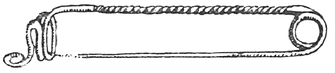
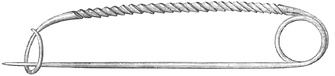
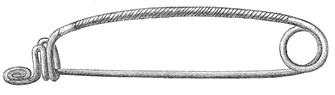
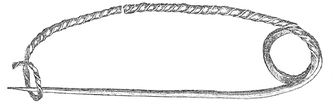
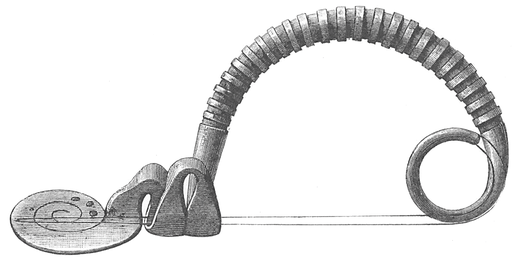
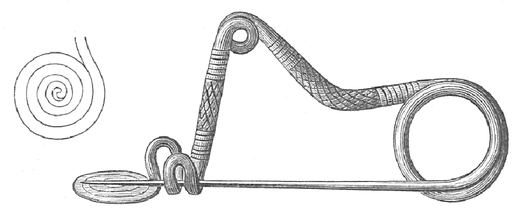
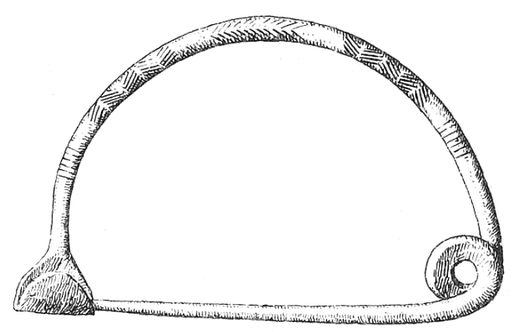
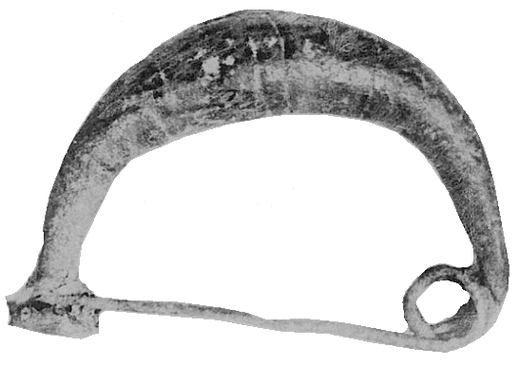
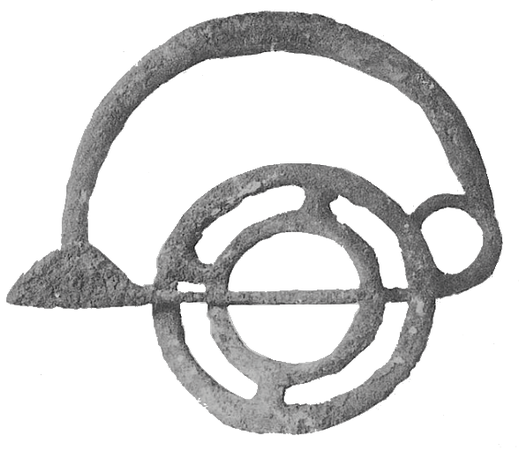
countries. These fibulae fall into four classes: (1) those with the simple bow, a disc and a spring on one side (Fig. 5); (2) those with a serpentine bow with a disc and a spring on one side; (3)
those with a simple bow with a pin catch and a spring either on one side or on both sides (Fig. 3); (4) those with a serpentine bow, a pin catch, and a spring on one side. The first two series
are almost contemporary; the first types of series 2 and 4 are more recent. All four series commence in the Bronze Age towards the end of its third period, but they have not all lasted for the
same time. Those with the disc have hardly survived the Bronze Age, whilst the type with the catch has given birth to the fibulae which were still in use several centuries after
Christ.
The body of the fibula begins by being straight and parallel to the pin. It was formed by twisting a long ordinary Bronze Age pin into a safety-
pin. This was found not to give room enough for the cloth of the garment, hence the bow shape was adopted; first the bow was very high and semicircular, then lower. The disc was originally formed
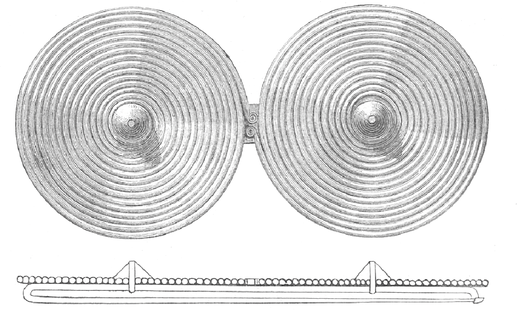
by sev-eral twists of a fine round wire; the number of twists became smaller, the wire became broader and flattened, and the diameter of the disc in-
creased. In some cases the original spiral can just be traced, then the disc becomes a complete plate, the body and spring are all of one piece like the modern safety pin. In series 3 the process
of evolution was much the same as in series 1. The bow is sometimes furnished with rings, with little or big ribs, but it more frequently bulges out. Many of the fibulae of this series have their
body formed of one or more pieces of amber, glass, or bone. The catch of the oldest examples of series 3 is very short, but it soon grows large and almost semicircular; the bow springs out of the
middle of the catch; later it is usually very small, but the bow always starts from the middle of it. It becomes very elongated, opening from above, and finally it terminates in a knob, at first
small, then very large. Next the opening of the catch is placed at the side instead of on the top. Finally the extremity of the catch curves up. This is the regular characteristic of the Etruscan
brooches of the Certosa type (Fig. 982).
The immediate derivatives from the simple form are found both in Hungary and in Bosnia. The type with the plain arched bow is found in all Italy, the Balkan, on the coast of Asia Minor, and in
the most ancient cemeteries of the Caucasus, especially at Koban. The fibulae with swollen bow are found also in Carniola, Hungary, the north of the Balkan peninsula, and in Greece, but the
enlargement often becomes a series of small knobs.
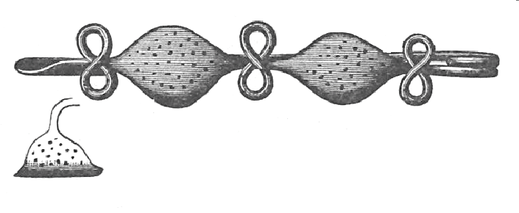
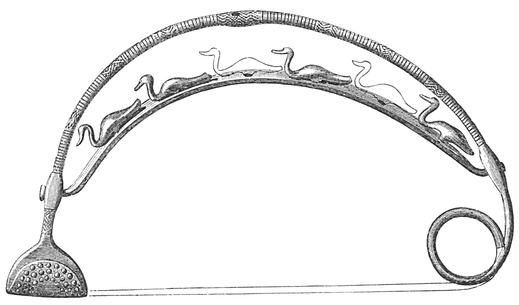
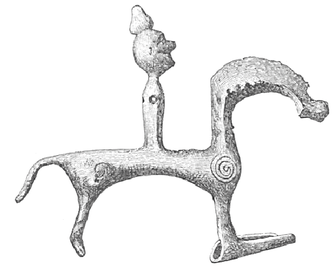
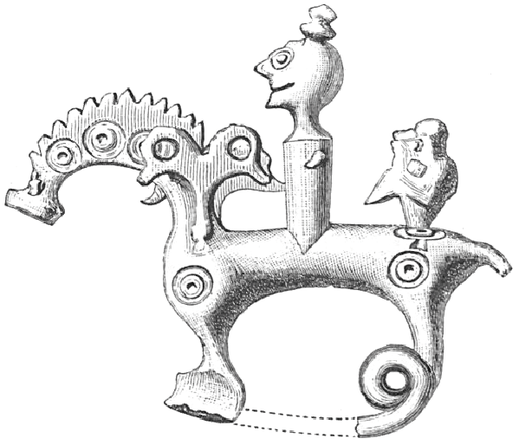
From the high-arched fibula with the middle of the bow enlarged come the forms known as the Boat and the Leech. Sometimes the nose is elongated and ends in a button; sometimes they are ornamented
with amber or decorated with animals on the back. An analogous fibula with a head of a mouflon was found at Koban.
The leech-shaped fibulae are found not only at Olympia, but also at Dodona, Greece.


The type derived from the high-arched bow, ornamented with knobs, glass beads and the like, is rare in the south, but is common to the north of the Apennines, especially around Lake Como and Lake
Maggiore.
Plain wire bows ornamented with a single bead, which are found along with the leech type at Corneto, are probably of later origin than the latter.
The serpentine fibula appears together with the boat-shaped type.
Southern Italy yields fibulae with a knob-shaped appendage and a similar one has been found at Olympia. They resemble those worn by some of the women depicted on the François Vase.
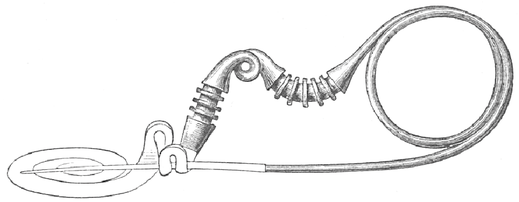
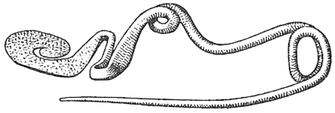
There is a class of serpentine fibulae with a bow formed of two wires which unite into a single pin. These are found in Italy and also at Olympia.
Both boat-shaped and serpentine fibulae are equally widespread through-
out Italy. The fibulae of the boat type are found in gold at Caere and Vulci. One of these is so beautiful that Mr S. Reinach thinks that it must be the work of a Greek settled in Etruria.
However, the explanation of Etruscan art as a whole already given also applies to the fine workmanship of these fibulae.
The Certosa type is common in the provinces of Bergamo and Como, the region of Este, the Austrian Alps and in Bosnia (Glasinatz).
When we pass to central and western Europe, we find that west of Bavaria the ancient Italian types are very rare, whilst they are common in Austria (Hallstatt), and Carniola (Watsch). All the
semicircular, boat-shaped, and serpentine forms are found at Hallstatt, which likewise yields types either unknown or at least very rare in Italy. But to these we shall presently
revert.
The Hallstatt people fastened both their under- and outer garments by means of fibulae.
Indeed, it can readily be shown that at all times cloaks fastened with fibulae were regarded as the characteristic of the fair-haired peoples of central and upper Europe. Thus when Tacitus wrote,
the sagum fibula consertum was universally worn by the tribes of Germany.
Scipio Africanus wore a Gallic sisyra furnished with fibulae; Claudius Gothicus in a letter to Regillianus, governor of Illyria, asks for two
cloaks fitted with fibulae (duo saga, sed fibulatoria). In a letter of Valerian there is also an allusion to duo pallia Gallica fibulata. That such cloaks were also employed in northern Greece is
shown by the fact that the Thessalians had a special word to designate a chlamys fitted with a fibula.
Though the Romans did not fasten the toga with fibulae, but only used them to secure some extra upper garment (lacerna, palla, sagum, paludamentum), yet there is some reason to believe that the
Sabine element in the Roman state had once used generally the fibula to fasten on their garments. Thus the Salii selected by Numa (himself a Sabine) from the Patricians, as priests of Mars, the
war god of the Sabine stock, were clad as warriors, and their costume, like the language of their hymns, naturally retained much that was obsolete. They wore tunics girt with bronze belts (such
as those found at Corneto, in upper Italy, and Hallstatt), trabeae fastened with fibulae, conical caps, reminding us of the conical helmets of the Po and Danube regions, and each carried in his
right hand a sword or lance, and in his left the ancile. The latter was probably not the Sabine, but rather the indigenous Italian shield. The story shows that it was a shield of no ordinary
shape.
From these considerations it follows that the upper garment with fibula is not indigenous in the lower parts of the Italian and Balkan peninsulas, and that when it is there found, it is probably
adventitious.
All the fibulae hitherto described have a spring at one side.
The Celts beyond the Alps had developed from their older fibulae (Figs. 1367, 1368, 1407, 1408) those furnished with bilateral springs. They then modified the fibula of the Certosa type (found in
the Alps and Bosnia as well as in Italy) by giving it a bilateral spring. This new type, known as the La Tène, has played a great part in the history of the fibula. It extends from the Danubian
regions to the valleys of the Seine and the Thames, and even to Ireland. The most ancient La Tène brooch has the lower extremity bent back like that of Certosa (Fig. 982). This curved portion
became longer and longer until it at last touched the bow, which it clasps. Finally it unites with the bow, leaving no trace of its origin save in the ring which once had served to join together
the curved up extremity and the bow.
The pin of the La Tène brooch, like that of the fibula with a single spring of series 2, is formed of the same piece as the body of the fibula.
At the commencement of the Christian era the La Tène type had given birth to the Roman provincial fibulae, and those in turn were the parents of the fibulae which the Germanic peoples made in the
first centuries after Christ in the epoch of the great migrations and — in Scandinavia — much later.
To increase the elasticity of the pin a spring was added to the front of the bow. Montelius terms the arc of both these series serpentine. There are two series (2 and 4) of these serpentine bows;
one with a disc (2), the other (4) with a catch. The evolution of the disc is the same as that in series 1. The catch of series 4 is seldom short, the oldest examples of it having the catch
elongated. Like the catch of series 3, that of 4 at first opened upwards, later on from the side. Some of the later specimens of the serpentine class have also the termination in a knob. In
series 2 and 4 the pin is usually formed of the same piece as the body of the fibula, but there are examples which show the pin separated and attached to the posterior extremity of the
bow.
According to Montelius, the earliest Italian fibulae date from the fifteenth century BC. This (he thinks) is proved by the presence of fibulae of this type in Greek tombs contemporary with the
Egyptian Amenophis III., but to this point we shall presently revert.
The Certosa brooches date from the fifth century BC., the oldest perhaps from the sixth. This is proved by their presence in Etruscan tombs which contain Greek painted vases of that
epoch.
The oldest La Tène fibulae are almost contemporary with those of the Certosa type, as is shown by their resemblance in all respects except the spring. It therefore follows that fibulae belonging
to types later than the earliest and earlier than the Certosa type, date from the fourteenth to the sixth century BC. If all these five intermediary periods have had almost the same duration, it
is evident, says Montelius, that each period represents 150 — 200 years, which gives approximately the age of each class of brooches; but if we know the age of the different kinds of brooch, we
can fix the date of each find which contains fibulae.
But to assume five periods of even roughly similar duration seems rash. The value therefore of the fibulae as a chronological criterion must be frankly discounted, no matter how reluctant we may
feel.
On the other hand, if it can be shown that all the various forms of fibula have spread from one original starting-point, the brooch can be used as a valuable criterion in questions of ethnic
movements.
Development of the various fibulae forms
Type 1: Fibulae with spiral disc and simple bow
The spiral disc was originally small, formed from the narrow, round wire, which is the direct continuation of the equally round and narrow body. Initially, the number of turns was usually very
large. The diameter of the spiral disc gradually increases in size as each turn becomes wider; the round wire soon becomes flattened and ribbon-like. As a result, the number of turns naturally
decreases, and the outer turns, which were originally equal to the inner ones, become significantly wider than them; finally, the inner turns atrophy almost completely.
The spiral shape of the disc gradually disappears, and the youngest discs show no trace of spiral windings at all. The bow, which soon becomes very high, even semicircular, is often decorated
with transverse lines or ribs; the center is sometimes spiral. Later, the bow becomes very strong; sometimes it is not solid, but formed by very thin and closely spaced transverse discs, which
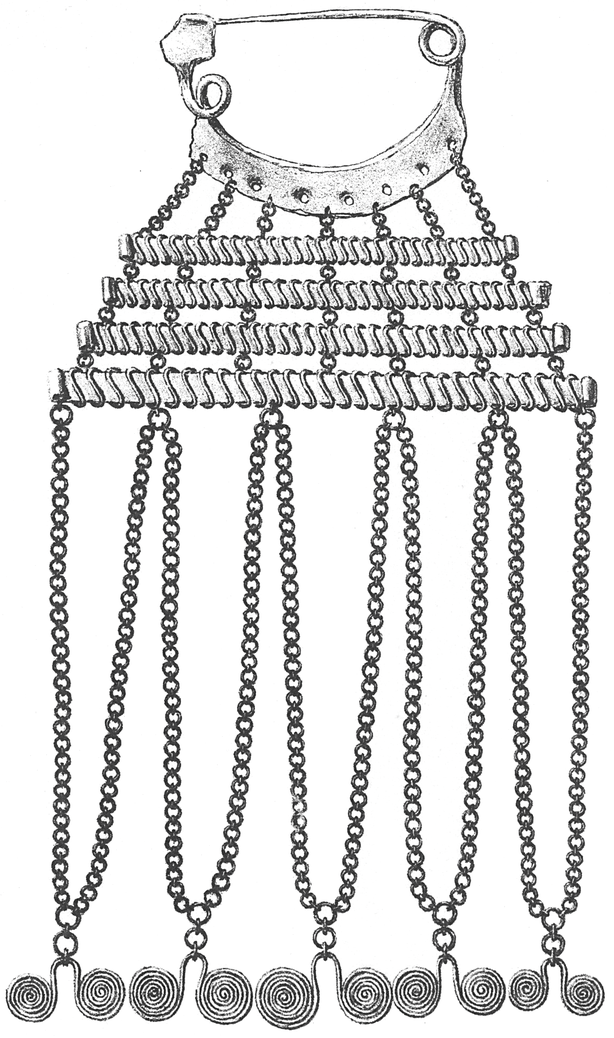
testifies to an almost unbelievable technical skill. Other fibulae have a broad, flat, oval bow, which in some areas is decorated with rows of small hanging rings and other appendages.
At the front bend, at the transition to the disc, a crossbar, sometimes very long, often develops due to the increasing width of the knee (fig. 146). Some very late fibulae of this group show a
doubling of the crossbar (see figs. 682, 684).
Type 2: Fibulae with spiral disc and serpeggianti
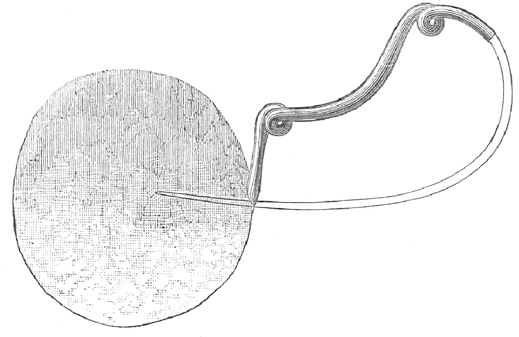
The spiral disc develops in the same way as we saw in the first fibula form described above, with a spiral disc and a simple bow. To provide more space for the fabric, the pin was often strongly
curved. To prevent it from breaking easily, it was sometimes formed from a separate piece; in this case, the pin rotates around a small pivot formed by the rear end of the bow.
Type 3: Fibulae with pin catch and simple bow
The bow, which (as in brooches with spiral discs and simple bow) initially becomes very high, even semicircular, and often colossal, later becomes lower and smaller. It is either narrow or
strong. Later, it sometimes becomes very strong and often hollow; such an bow is often open at the bottom („a navicella“).
The pin catch of older arched fibulae is often very large, sometimes decorated with chased dots, but later becomes smaller. It is attached at the center, so that its back part is as long as the
front. Later, the front part of the pin catch is lengthened; at the same time, the back part shortens, finally disappearing more or less completely. The pin catch, thus lengthened at the front,
gradually acquires a considerable length.
For a long time, it was slightly tapered at the front. Later, it ended in a knob, which initially became small but later became larger. On the latest fibulae of this type, the knob of the pin
catch often pointed upwards. This category includes the so-called „Certosa fibulae,“ whose bow often forms an angle in the middle.
All the brooches described here have a one-sided spiral at the beginning of the pin. A new group—the La Tène brooches—is formed by brooches with a two-sided spiral. The bow and pin catch of some
of these brooches are identical to the Certosa brooches (see The Fibulae of Europe, Volume II).
The two-sided spiral gave the brooches new vitality and they survived for a long time: first as La Tène brooches and later as Roman brooches, whose descendants survived the Migration Period in
the Germanic lands.
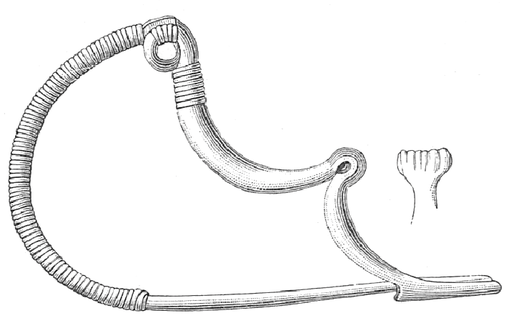
Type 4: Fibulae with pin catch and serpeggianti
The pin catch is initially short but soon becomes longer. In some rare cases, the pin is formed from a separate piece; in these cases, the pin rotates around a small pivot formed by the rear end
of the bow.
Sometimes the pin is sharply bent, apparently to create more space for the fabric. The front spiral is first replaced by a knee, which is soon adorned with two small horns; on either side of this
knee, the curve is often widened, forming two pairs of small points. Later, the rear spiral, at the beginning of the pin, also disappears and is also replaced by a knee, which, like the front
knee, is often adorned with two small, short, straight horns. Finally, for the sake of symmetry, the two pairs of small points mentioned above are given round knobs like the horn fibulae (from
the Iron Age onwards).
Types 1 and 2 begin at approximately the same time, as the types are probably almost the same age. That the 3rd and 4th types begin somewhat later is natural, because the brooches with the bent
front must be younger than such primitive forms. Numerous finds prove that the types of Central Italian brooches actually appeared in the order indicated by the typological relationships, as the
overview of the forms presented here shows.
Although types 2 and 4 begin somewhat later than types 1 and 3, they all run parallel. Fibulae with pin catch, however, last longer than those with spiral discs. Of the fibulae with pin catchs,
those with a bent front (serpeggianti, type 4) end much earlier than those with a simple bow (type 3), which outlive all other types for a long time.





European Fibulae: From the Bronze Age to the Hallstatt period
By Carsten Rau
Publication date: April 20, 2026
Language: English
Print length: 511 pages
2.373 pictures
ISBN-13: 979-8258221179
Item weight: 635 g
Dimensions: 12.85 x 2.95 x 19.84 cm