
The Swedish fibulae of the Bronze Age by O. Montelius
The second bronze period.
From the middle of the 16th to the end of the 14th century B. C.
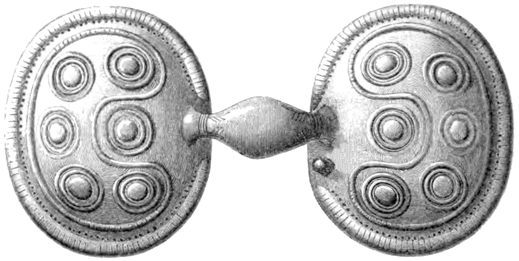
Figs. 1132—1140. Bronze “fibulae” (brooches). The Scandinavian fibulae consist of two parts, the pin being made in one piece by itself; but in other respects they resemble the contemporaneous
Italian fibulae, which have the same form as the modern safety pin, with the pin made in one piece with the brooch itself. Like the Scandinavian flanged axes, the fibulae of the North are the
result of a connection between the countries of the Mediterranean and Scandinavia in the earlier Bronze Age. On the oldest Northern fibulae, as on the oldest Italian ones, the point of the pin
rests against a hook (Figs. 1132–1134). On most of the northern specimens, however, the point of the pin rests on a small spiral-shaped plate (Figs. 1136–1140), as is the case with many Italian
ones too; but the former, in contradistinction to the latter—which have the pin cast in one piece with the rest—have a similar spiral plate also at the other end. The Scandinavian and Italian
fibulae also have a similar “bow”. This is on many of them narrow and round, on others broader, leaf-shaped, and flat (Figs. 1133, 1134, 1140). For the evolution after this time, see the
following periods. Fibulae like Figs. 1132–1140, as many discoveries in tombs testify, were worn by both men and women.
They are rather common in southern Sweden, especially in Skåne and Västergötland; in other parts of southern Sweden they also occur, as in Norway (particularly in Jæderen, the south-western part
of the country). In Denmark they are very numerous. In Schleswig-Holstein and Mecklenburg many are found, and some in other parts of northern Germany. In Denmark and Schleswig-Holstein some
brooches, belonging to the end of the 2nd period and the transition to the 3rd, are of gold or of gold-plated bronze.


The third bronze period.
From the beginning of the 13th to the end of the 12th century B. C.
Figs. 1142–1158. The narrow bronze thread of which the spiral plates are formed is first rolled so tightly that it loses its round shape and is squeezed into a narrow fillet standing on its edge
(Figs. 1143, 1145); then it is flattened out into a horizontal ribbon, which gradually wid-ens. Only the last spiral, which is thicker than those inside it, retains its round shape; it is
generally ornamented in such a way that it looks twisted. The plates, at first narrow, soon become larger and larger. At the same time, the central part of the fibula is altered; it becomes more
and more bow-shaped and shorter than before.





European Fibulae: From the Bronze Age to the Hallstatt period
By Carsten Rau
Publication date: April 20, 2026
Language: English
Print length: 511 pages
2.373 pictures
ISBN-13: 979-8258221179
Item weight: 635 g
Dimensions: 12.85 x 2.95 x 19.84 cm